StrataFi — economic architecture for advisory firms.
A consequence-aware modelling engine for trusts and estates counsel, CPAs and family offices. It starts at the asset, characterises it, maps who owns it and models what happens when it moves.
It starts at the asset
Asset
What the client owns, with its identity and economic attributes.
Characterisation
Its legal and tax character.
Ownership
Who owns it, directly and indirectly.
Entity
The structures, discounts and relationships around ownership.
Authority
Governing instruments, statutes and fiduciary powers.
Consequence
The tax and economic impact of a transaction before it happens.
Economic
One model connecting every relationship and outcome.
What it does
Asset matrix
Every asset with its character, basis, ownership and authority attached.
Consequence engine
Recognition, basis, gift, estate, income and liquidity effects modelled per transaction.
Form 706 generation
Schedule placement and estate tax computation produced from the engine, not retyped.
Rules as data
Tax logic authored and validated by licensed counsel in a rules library, not buried in code.
Authority surface
The statutes and rulings behind each position, surfaced with the position.
Client intake
Schema-driven onboarding that fills the model rather than a filing cabinet.
What it actually looks like
Three screens from a live engagement. The client and the numbers are synthetic; the behaviour is not.
The navigation is the method
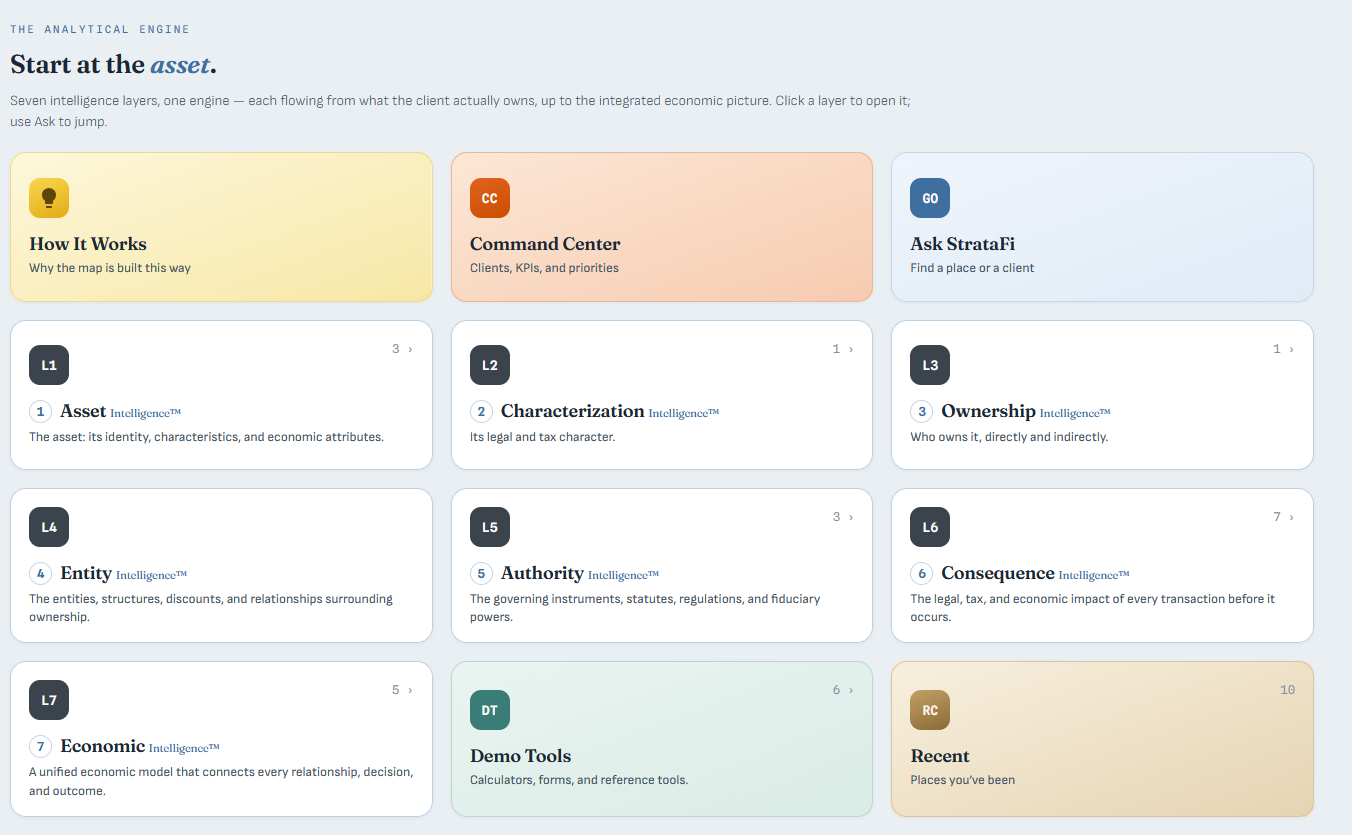
Most advisory software gives you a menu of twenty-eight items in whatever order they were built. StrataFi gives you seven numbered layers in the order the analysis actually runs: what the client owns, what it legally is, who owns it, through what structures, under what authority, with what consequence, adding up to what economic picture. Click a layer and its modules fan out around it.
- Three tiles sit outside the sequence: how the model works, the command centre for clients and priorities, and a plain-language search for jumping straight to a place or a person.
- The number on each tile is how many modules live under it, so nothing is hidden two levels deep.
- The layer you were last in is remembered, because advisory work is interrupted constantly.
A dossier that admits what it does not know
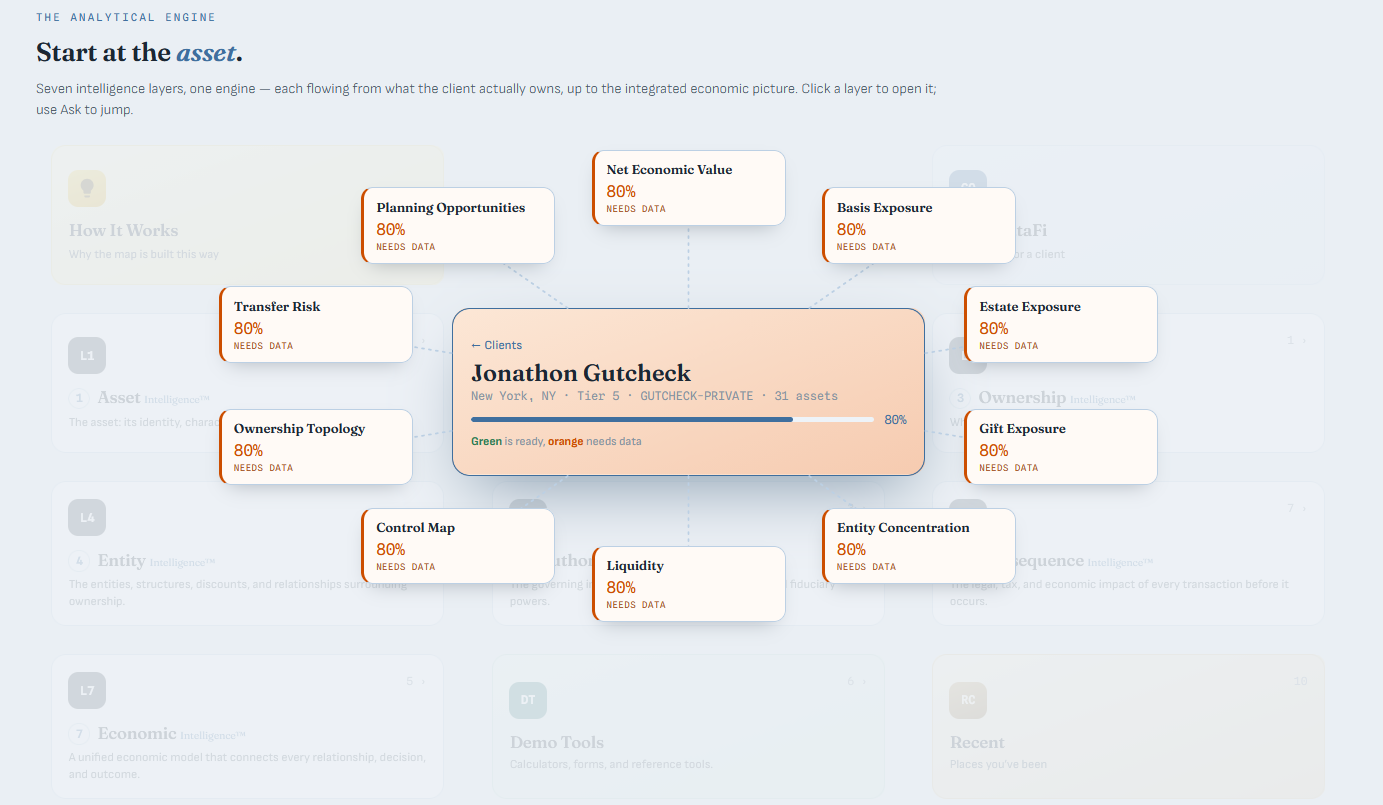
Open a client and ten indicators arrange themselves around them: net economic value, basis exposure, estate and gift exposure, liquidity, entity concentration, control, ownership topology, transfer risk and detected planning opportunities. Each one is either green, meaning it computed from real data, or orange, meaning it cannot be trusted yet.
- Orange is the whole point. An indicator that lacks the underlying data says so instead of showing a confident wrong number, which is the failure mode that gets professionals sued.
- Every indicator shows its arithmetic on demand, line by line, rather than presenting a total to be taken on faith.
- From an indicator you jump straight to the module that owns it, with the client still loaded.
Intake that asks less, not more
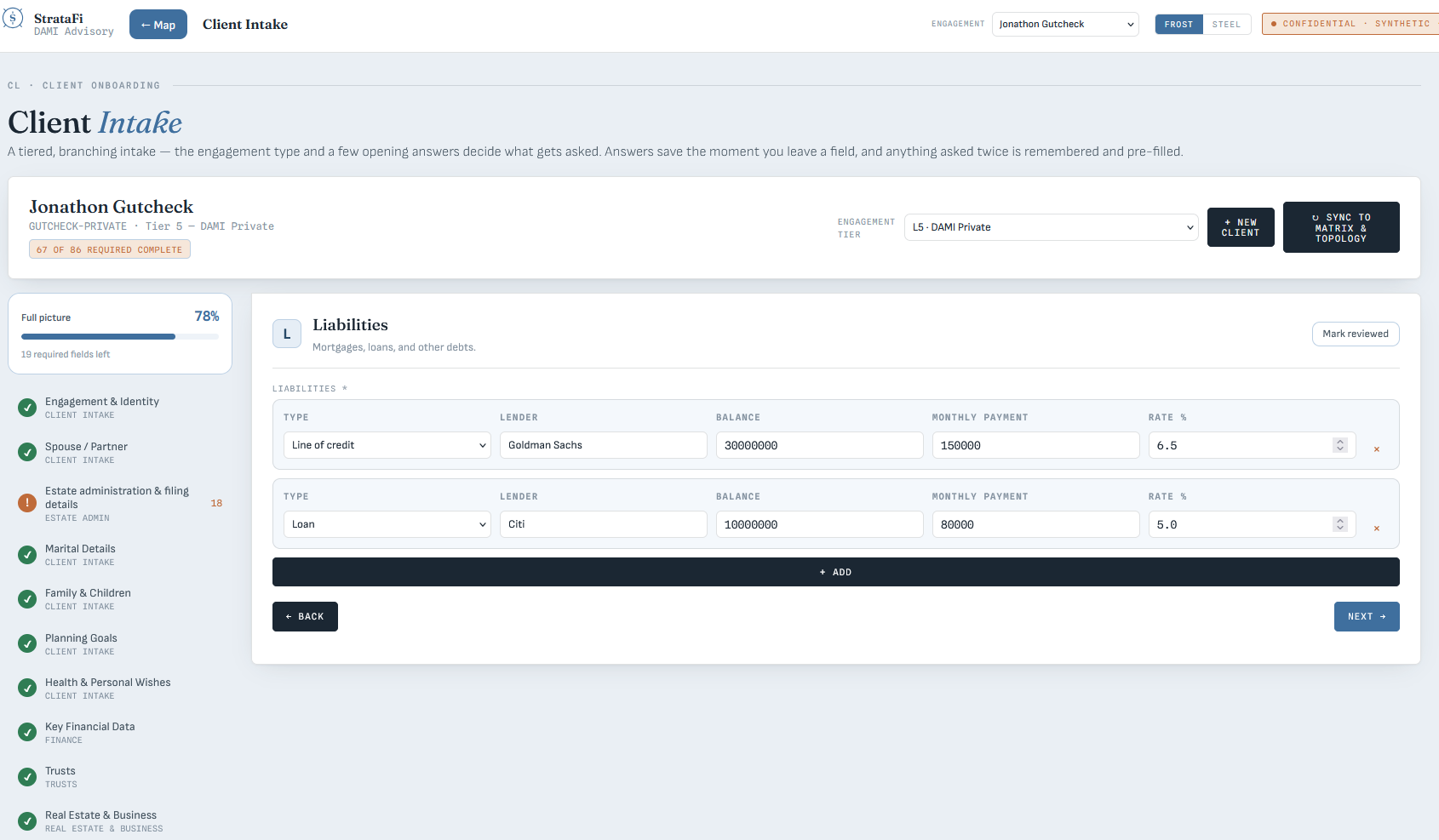
The engagement tier and a handful of opening answers decide which questions get asked at all, so a straightforward engagement is never marched through eighty-six fields to reach the nine that matter. Answers save the moment you leave a field, and anything asked twice is remembered and pre-filled.
- The left rail is the honest scoreboard: which sections are complete, which are reviewed, and exactly how many required answers are outstanding in each.
- Liabilities are first-class rather than a footnote, because a plan built on gross values and a vague sense of the debt is not a plan.
- Finishing intake pushes straight into the asset matrix and the ownership graph, so collection and modelling are one motion rather than two systems.
Built to be doubted
Advisory work does not accept a black box. Every conclusion the engine reaches can be traced to the authority behind it and the input that drove it, which is the only basis on which a professional will put their name to it.
Advisory firms work differently.
StrataFi is sold into professional firms rather than through the merchant channel. Tell us about your practice.